EP08
|
|||||||||||||||||||||||||||||||||||||||||||||||||||||||||||||||||||||||||||||||||||||||||||||
|
EP08-001 in its original livery working a train from Warsaw to Lublin;
location and date unknown. Photo by D. Adamovich (postcard from my
collection).
EP08-001 again, photographed in
...and EP08-012, photographed on the same occasion.
Another picture of the EP08-012 taken almost thirteen years later, on
May 18, 2017, at the Warszawa Wschodnia station.
Another picture of the EP08-001 in new PKP InterCity livery:
probably at the end of a wearisome day. Warszawa
Wschodnia station, February
24, 2010.
EP08-011,
photographed at the same location on June 10, 2006.
The
same location and the same locomotive, but in new PKP InterCity livery: October 12, 2011.
EP08 side drawing by M.Ćwikła (SK vol.4/2001).
EP08-010 at the Warszawa Wschodnia station,
Another picture of the EP08-010, taken near the Warszawa Olszynka Grochowska depot on
...and yet another, this time near the Warszawa Zachodnia
station;
EP08-007 in a new (and somehow surprising!) PKP InterCity navy-blue
livery; Warszawa Wschodnia station,
Another EP08 in new PKP
InterCity livery: EP08-013, photographed at one of my favorite spots near
Warszawa Zachodnia station on
EP08-013 approaching the Wrocław Główny station; photo taken on
The same locomotive photographed at the Warszawa Wschodnia
station on August 18, 2010.
EP08-006, still in old livery. Warszawa Wschodnia
station, April 29, 2008…
…and in the ultimate PKP
InterCity livery: the same location, July 16, 2014.
EP08-009, Warszawa Olszynka
Grochowska depot, July 10, 2008.
The same locomotive in new PKP InterCity livery; Warszawa Wschodnia station, May 28, 2009.
EP08-001, Warszawa Wschodnia
station, April 17, 2013.
EP08-014, location and date unknown. This locomotive was withdrawn in
March 2000 and scrapped. Photo from my collection.
Warszawa Wschodnia again: EP08-011, June 21, 2017…
… and again:
EP08-008, November 13, 2018.
EP08-006, location and date unknown. Photo by Paweł
Winnicki (postcard from my collection).
Two pictures, taken at the Warszawa Wschodnia
station on July 14, 2022: EP08-006…
… and EP08-001; the latter displays historical orange livery, which
was restored in May 2017.
Another picture of the EP08-001, taken at the same location on April
18, 2023.
Warszawa Wschodnia again: EP08-007, October 5,
2023…
… and once again: EP08-009, June 27, 2024.
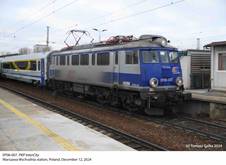
The same location: EP08-007, December 12, 2024. |
In late 1960s, in view of track upgrading on principal routes, it was decided to build electric locomotives for passenger traffic, capable of higher speed – 140 to 160 km/h. New machines were to be developed from those already in service – EU05 (supplied by Škoda in 1961) and EU07 (license-built variant of British EU06, built by Pafawag of Wrocław since 1964). Between 1971 and 1977, 27 EU05s (all machines then in service) were rebuilt to the EP05 standard, with reduction gear ratio changed from 84:37 to 77:44 and maximum speed increased from 125 km/h to 160 km/h. The last of them was withdrawn from service in May 2008. High-speed variant of the EU07, designated EP08
(factory designation type 4Ea), had reduction gear ratio changed from 79:18
to 77:24, maximum speed being set at 160 km/h. Journal shaft bearings were
retained, albeit with improved lubrication and additional oil pump fitted.
Four examples (EP08-002 through 005) were supplied in late 1972; contrary to
EP05, they were all new machines, not conversions. In early 1973, EP08-001
(factory designation type 102E) was delivered; this machine differed from its
predecessors mainly in roller shaft bearings and slightly modified trucks.
Tests immediately proved the latter variant to be superior, although running
qualities at high speed still left something to be desired. It was planned to
build 100 locomotives of this type, but roller bearings had to be imported,
so only ten further examples followed between 1975 and 1976. Externally they
were almost identical with early production EU07s and differed mainly in
orange and red livery. Their service speed was finally reduced to 140 km/h.
Four EP08s with journal bearings were rebuilt to the EU07 standard (becoming
EU07-241 through 244, the last locomotives of this type from Pafawag) in
1976 and 1977. EU07-242 (ex EP08-002) was modernized in 2005 and re-numbered
EP07-242; it was sold to a private operator in December 2014. EU07-243 (ex
EP08-004) underwent similar modernization and re-numbering, also in 2005. Apart from EP08-015, which was written off after a
serious crash in December 1994, all machines of this type still remained in
service in late 1990s, based in Warsaw and Wrocław.
Pending the introduction of modern EU11s, their withdrawal seemed inevitable,
but only EP08-014 was in fact written off in March 2000 and scrapped in July
2006. After the entire EU11 program had collapsed (all locomotives of this
type were finally sold to Italy and none saw service with PKP), it was
decided to keep all remaining nine EP08s in use. Today they form a part of
the PKP InterCity fleet and operate mainly between Warsaw and Poznań with express trains, but sometimes can be seen
also on other principal routes. All are currently based in Warsaw. Together
with two EP05s (finally withdrawn from use in 2007 and 2008) and 47 EP09s
they made up a motley collection of express locomotives in the PKP
InterCity service. In 2008 the company decided to purchase modern ES64U4
‘Eurosprinter’ locomotives from Siemens. Main
technical data
1)
Maximum service speed. 2)
Between 1976 and 1977 EP08-002 do 005 with journal shaft
bearings rebuilt to EU07-241 through 244. References and
acknowledgments
-
AL; -
SK vol. 4/2001; -
www.kolejowaklatka.org (website by Marek Dąbrowski). |
||||||||||||||||||||||||||||||||||||||||||||||||||||||||||||||||||||||||||||||||||||||||||||