Tr11
|
|||||||||||||||||||||||||||||||||||||||||||||||||||||||||||||||||||||||||||||||||||||||||||||||||||||||||||||||||||||||||||||
|
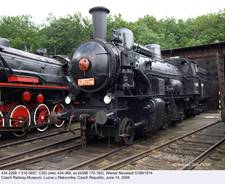
ČSD 434.2298 is the ‘reko’
variant, previously kkStB 170.162 (Wiener
Neustadt 5199/1914). This engine is on static display at the Czech
Railway Museum in Lužna u Rakovnika. Photo taken
on June 14, 2008.
Another ‘reko’ engine:
derelict 434.2218 (kkStB
170.98, StEG
3921/1913), recently transferred to Lužna. Photo taken on the same
occasion.
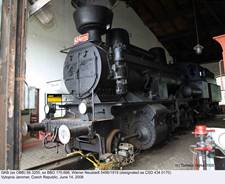
Although bearing the ČSD designation 434.0170, this engine is in fact ex-GKB 56.3255,
which began life as BBÖ 170.666 (Wiener Neustadt 5496/1919).
Photo taken at the Jaroměř depot on the same day (not a bad one, indeed!). This
is the original variant running on saturated steam, obtained in exchange for
another heritage locomotive.
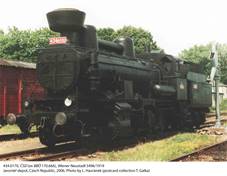
Earlier picture of the ČSD 434.0170, taken at the Jaroměř depot in 2006. Photo by L. Havránek (postcard from my collection).
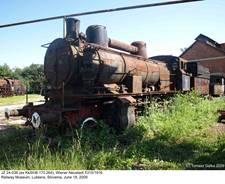
JŽ
24-036 is the former kkStB
170.264 (Wiener
Neustadt 5315/1916). This engine is kept at the railway museum in Lublana and awaits reconstruction. Photo taken on June
18, 2009.
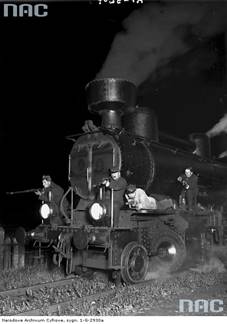
Polish railwaymen
with rifles and bellicose faces pose on a 170 (original service numbers have
probably been painted over). According to available data, this picture was
taken in 1918. Source: National Digital Archives (www.nac.gov.pl). Used by permission.
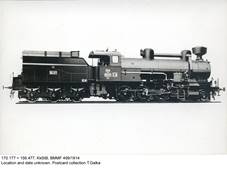
KkStB 170.177 (BMMF 499/1914) with the 156.477 tender. This engine
later served with ČSD as 434.081, to be rebuilt and re-numbered
434.2247. It remained in service until July 1970. Postcard from my
collection.
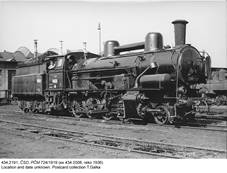
Another ‘Reko’
engine from the ČSD fleet: 434.2191 (former 434.0308), PČM 724/1919, rebuilt in 1936. Location and date unknown
(postcard from my collection).
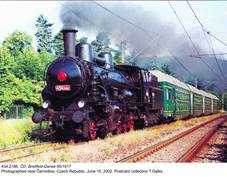
Czech 434.2186 with a special train,
photographed near Černošice, Czech Republic, on June 15.2002. Postcard from my
collection.
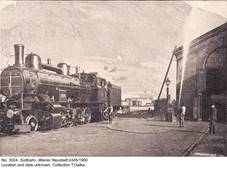
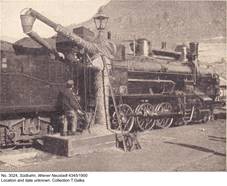
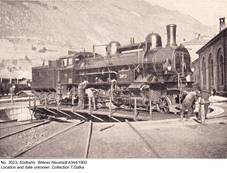
Three pictures of Südbahn engines
from my collection: No. 3024 (Wiener Neustadt 4345/1900)…
…the same engine during water replenishment…
…and No. 3023 (Wiener Neustadt
4344/1900) on a turntable. Details of location and date are lacking.
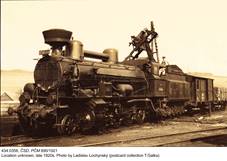
ČSD 434.0358 (PČM 890/1921, initially numbered 170.844),
location unknown, late 1920s. Photo by Ladislav Lochynský
(postcard from my collection). In 1939 this engine was rebuilt and
re-numbered 434.2282, to be finally withdrawn in February 1969.
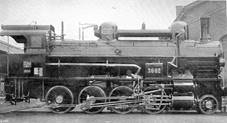
Südbahn No. 3002 (Wiener Neustadt 4070/1898), probably factory photo. This
engine later became FS 729.054 and
finally ended up in Yugoslavia as JDŽ 24.067. Source: J.R. Howden, The Boys’ Book of Locomotives’, E. Grant
Richards, 1907 via www.commons.wikimedia.org.
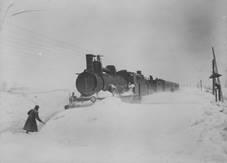
An unknown Tr11 stuck in a snow-drift;
location and date (before 1939) unknown. Source: National Digital Archives (www.nac.gov.pl).
Used by permission.
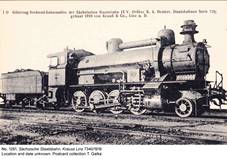
Sächsische Staatsbahn
No. 1281, Krauss Linz 7340/1919. In
1922 this engine was sold to Austria and re-numbered 170.750; later it became
DRG 55 3305 and in 1940 was
transferred to Hungarian MÁV. Returned to ÖBB in 1950, it was written
off in April 1951. Location and date unknown (postcard from my collection).
KkStB 17002 (later 170.02, Wiener Neustadt 3951/1897), location
and date unknown. After the war this locomotive went to Italy and became FS 729.001. Source: Die Lokomotive
June 1904. |
In
mid-1890s trains running through the Arlberg pass in Austria were hauled
mainly by kkStB class 73 four-axle engines.
In view of rapidly increasing traffic, these locomotives soon were found too
weak and slow for this demanding line. In order to provide a suitable
successor, Karl Gölsdorf designed an entirely new
locomotive, which apperared in 1897 and was
designated class 170. While retaining some features typical to earlier Gölsdorf’s designs, including compound steam engine, twin
steam domes connected with a large horizontal tube and Hardy vacuum brakes,
new engine was in some respects exceptional. Due to large boiler, with total
heating surface of almost 250 sq.m, it was one of
the best steamers in Europe; at the same time axle load barely exceeded 14 tonnes, which was essential for comparatively weak tracks
common in Austro-Hungary. Initial trials were very successful: prototype (Wiener
Neustadt 3950/1897) attained 84 km/h and proved capable of hauling a
220-tonne draft on a 26‰ gradient at 25 km/h, a very good result for that
time. Despite
this success, production was slow in gaining momentum. Only one more engine
for kkStB was built in 1897, six in 1898 and
one in 1901. All these locomotives, which were given service numbers 17001
through 17009, later 170.01 through 170.09, had 3.36 sq.m
grates and brakes on two axles only. Next six examples, 170.10 through
170.15, delivered in 1905, featured enlarged grates (3.91 sq.m)
and brakes on three axles. In the meantime, class 170 was ordered by Südbahn, which received 54 examples between 1898
and 1908 (service numbers 3001 through 3054).
All these engines were built by Wiener Neustadt. Production for
state railways started in the earnest, with various minor modifications, in
1913 and lasted until 1919. In all, 783 examples were built against kkStB orders by WLF (Floridsdorf,
234), Wiener Neustadt (227), BMMF (PČM, 149), StEG (113), Breitfeld
& Danĕk (52) and Krauss Linz
(8). Of these, fifty engines from Wiener Neustadt (170.646 through
170.695) and two from Krauss Linz (170.748 and 170.749) were completed
after the collapse of the Austro-Hungarian empire and delivered to
newly-formed Austrian state railways, which later became Bundesbahnen
Österreichs (BBÖ). Two more (Krauss
Linz 7340/1919 and 7341/1919) were sold to Saxon railways and included
into class IX V, despite considerable differences. They were numbered 1281
and 1282. In 1922 these untypical engines were sold to BBÖ and became
170.750 and 170.751, respectively; they remained in use until early 1950s.
Finally, between 1919 and 1921, three Czechoslovakian factories built further
71 engines for state railways ČSD, initially with consecutive kkStB service numbers 170.784 through 170.854 (PČM
– 39, Breitfeld & Danĕk
– 22 and Škoda – 10). This gives the grand
total of 908 examples, which makes class 170 the most numerous
Austro-Hungarian locomotive type ever. Class
170 had initially been conceived as a powerful locomotive for passenger
trains on difficult mountain lines, but finally emerged as a universal heavy
freighter – no wonder with 1260 mm drivers and tractive effort exceeding 11 tonnes. When ordered in quantity for kkStB
in 1913, this engine – a compound running on saturated steam, with slide
valves – was already obsolescent, as steam superheating had been widely
accepted. This may perhaps be attributed to the influence of Gölsdorf’s school, which favored compounds. In fact, a
development version running on superheated steam was soon ordered, but it was
not completed before Gölsdorf’s death in 1916. This
engine was put into production in 1917 as class 270, but only a handful were
delivered to kkStB. Last 170s left
production lines in 1921, almost 25 years after the prototype, when their
design concept had already become anachronistic. After
WWI, BBÖ were left with 237 examples (including those built after the
Armistice and those taken over from Südbahn).
The rest were divided between four countries. The largest number went to
Czechoslovakia: ČSD took over 305 examples, excluding those built
after the war, classed 434.0. Italian state railways acquired 80 engines from
kkStB and 35 from Südbahn
(FS class 729). Railways of the Kingdom of Serbs, Croatians and
Slovenians (SHS – later Yugoslavia) were allocated 22 engines from kkStB and 12 from Südbahn;
in 1933, all were taken over by JDŽ
(Jugoslovenske Državne
Železnice) as class 24. Despite obsolescence,
most of these locomotives remained in service until WWII. In Czechoslovakia,
where 434.0s were among the most numerous and important engines in service, a
major reconstruction program was launched, aimed at improving economy and
featuring conversion to superheated steam and single-expansion steam engines
with piston valves. First rebuilt locomotive, 170.11 (WrN
4581/1905) was delivered by Škoda in 1924,
three years after the acceptance of the last brand-new 170. Until 1925,
further eight examples were rebuilt; all were re-classed 434.2 and given new
service numbers. It should be noted that, despite having a large number of
class 434.1 engines, which corresponded to kkStB
class 270, ČSD decided to develop an indigenous conversion design
rather than copying the Austrian pattern. Reconstruction program was
re-commenced in 1930 and continued until June 1951 (!), finally including 345
engines – last of them was 434.0318 (PČM 866/1920). This conversion
was considered very successful and 434.2s remained in service for a long
time, last three examples being withdrawn in 1980. Poland
acquired 146 engines of this type. Several (probably six) had been captured
by Russian troops during the 1915 offensive and saw some service in Ukraine,
converted to the 1524 mm track. They were re-converted to standard gauge by WSABP
in Warsaw, but one (WLF 2479/1917, ex kkStB
170.617) was probably never restored in service and written off before 1924.
With the introduction of new designation system in 1923, all remaining 145
examples were classed Tr11. As with most locomotives of Austrian origin,
Tr11s served mainly in southern and south-eastern Poland, assigned to
regional PKP managements in Kraków and Lwów. Apart from fitting Westinghouse air brakes instead
of Hardy-type vacuum ones, which was completed in 1936, modifications were
few and included mainly standard Friedmann-type
injectors and fittings. Several Tr11s were oil-fired: this conversion had
been introduced by kkStB even before the
war. Typically coal-fired engines ran with three-axle Austrian tenders (PKP
class 16C11), but smaller 14C11s were also used. The main shortcoming of Tr11
was its open cab, which was a nuisance for crews, especially in winter and
during reverse running; various makeshift improvements did little to
alleviate this problem. In
September 1939 the majority of Tr11s – 107 examples – fell into Soviet hands.
They retained their original PKP designations, written in Russian
script. Some (according to LOZD, about forty) were converted to the
1524 mm track and sent eastwards or transferred to industry. 38 examples were
captured by Germans. Apart from Tr11-71 and Tr11-80, which were badly damaged
and formally written off in 1943, they were included into DRG class 5631-34
(together with their Austrian, Czechoslovakian and Yugoslavian kinsmen) and
numbered 56 3336 through 56 3371. Later Germans captured further eighteen
Soviet engines, of which two were used by Wehrmacht, one by Ostbahn and fifteen were impressed into DRG
as 56 3391 through 56 3400 and 56 4251 through 56 4255. After the capture of
Odessa, five Tr11s were taken over by Romanian forces. Four were impressed
into the CFR service as 140.901, 140.903, 140.921 and 140.922 (in 1947
they were returned to the Soviets), the fifth one, ex Tr11-122, was badly
damaged and written off in 1946. Only 33 ex-PKP Tr11s were returned
after the war and eight of them were not restored in service, due to poor
condition. In fact, four of them were handed over by DR only in 1956,
when this class had already disappeared from the PKP inventory. Apart
from them, however, Polish railways acquired sixty engines of this type from
the DRG inventory that had not been evacuated from the Polish
territory by retreating German forces; most of them were former ÖBB
locomotives, but some came from Czechoslovakia, Italy or Yugoslavia. Of
these, two ex-ČSD engines (ex 434.270 and 434.295 – both class 434.2)
were returned in 1947 and eleven were not restored in service, so post-war
class Tr11 finally numbered 72 examples. Given their obsolescence, it is not
surprising that their post-war service was not long. Sixty were withdrawn
until 1952 and last two, Tr11-48 (ex 170.738, StEG
4271/1918) and Tr11-54 (ex 170.184, BMMF 506/1914) survived until
mid-1955. Several examples were transferred to industry or used as stationary
boilers and possibly survived a few years more, but detailed information is
lacking. No
Tr11 has been preserved in Poland, but as many as eight locomotives of this
type still exist in Czech Republic (five), Austria, Slovakia and Slovenia;
five of them, however, are ČSD class 434.2 ‘reko’
engines. Currently only one of them is operational, namely 434.2186 (ex
434.1048, kkStB 170.323, Breitfeld
& Danĕk 95/1916), based in Prague. GKB
56.3115 (ex kkStB/BBÖ 170.233, WLF
2180/1914) from Graz, Austria, saw last service in 2002 and, after a boiler
failure, probably has not yet been repaired. This engine represents the
original variant running on saturated steam. Ex-ČSD 434.2338 (ex 434.0226,
kkStB 170.560, BMMF 646/1917), based
in Vrutký, Slovakia, was transferred to Košice with the intention to bring it back to the
operational status; this has not yet been realized and the engine is now
dismantled. This is the only preserved engine of this type fitted with Giesl exhaust nozzle. Main technical data
1)
Increased to 1300 mm in the PKP service. 2)
After WWII. 3)
Including post-war production in Czechoslovakia (71
examples). 4)
Early production engines. 5)
Ultimate production variant. 6)
Later Westinghouse. List of
vehicles can be found here. References
and acknowledgments
-
Monographic article by Bogdan Pokropiński (KMD vol.
2/2006); -
PNPP, EZ, EDÖ; -
www.pospichal.net/lokstatistik
(website by Josef Pospichal); |
||||||||||||||||||||||||||||||||||||||||||||||||||||||||||||||||||||||||||||||||||||||||||||||||||||||||||||||||||||||||||||