Pm3
|
|||||||||||||||||||||||||||||||||||||||||||||||||||||||||||||||||||||||||||||||||||||||||||||||||||||||||||||||||||||||||||||
|
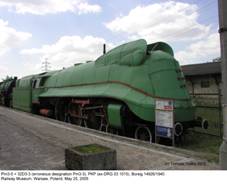
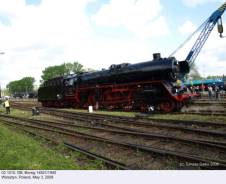
Pm3-5, erroneously designated Pm3-3 (Borsig
14926/1940) can be seen at the Railway Museum in Warsaw; photo taken on
May25, 2005
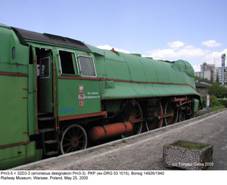
Another picture taken on the same occasion…
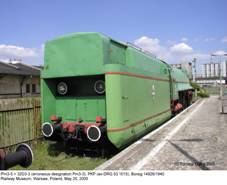
… and yet another, showing tender details (after
restoration; in PKP service
tender streamlining was partially removed).
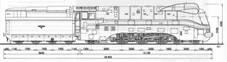
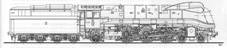
Side drawing of the 0310 in its original
version, with ‘smaller’ streamlined cowling…
… and of Pm3 in PKP service, mid-1950s. Both drawings by M. Ćwikła
from SK vol. 8/2001.
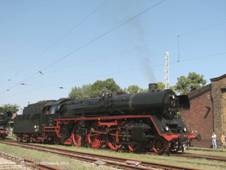
Beautiful German Reko 03 1010 (Borsig 14921/1940) during steam locomotives parade
in Berlin on August 21, 2005 (courtesy Tomek Drzewiecki,
who happened to be in the right place at the right time).
In 2008, Halle-based 03 1010 participated in
the Wolsztyn steam gala; photo taken on May 3.
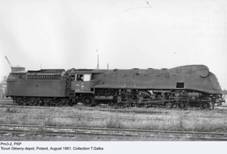
Pm3-2, Toruń Główny depot, August 1961. Photo from my collection.
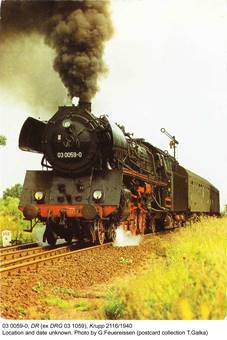
DR 03 0059-0 (Krupp
2116/1940), former 03 1059, location and date unknown. This locomotive,
rebuilt with oil firing in 1965, was withdrawn in September 1981. Photo by G.
Feuereissen (postcard from my collection).
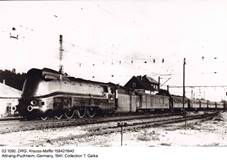
Streamlined 03 1090 (Krauss-Maffei 15842/1940), photographed
in Attnang-Puchheim in 1941. Photo from my
collection.
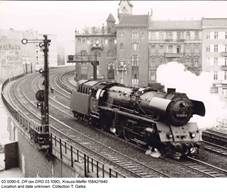
The same locomotive in its Reko version,
as 03 0090-5, in the DR service;
location and date unknown. Converted to oil firing in 1965, it was withdrawn
in July 1985 and is currently owned by Mecklenburgische Eisenbahnfreunde
Schwerin e.V. Photo
from my collection. Several other photos of Reko 03s in the DR service may be found here.
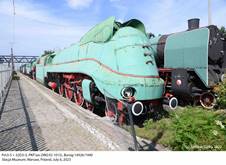
Pm3-5 again: Stacja Muzeum (formerly Railway Museum),
Warsaw, July 6, 2023. |
Some
measures aimed at drag reduction were employed in locomotive design as early
as in the beginning of the 20th century – good example is provided
by Swedish class F of 1914, with conical smokebox door and V-shaped front cab
wall, despite maximum speed of a mere 100 km/h. Such features may be
attributed to aesthetic rather than aerodynamic considerations, but partial
or full streamlining was another thing. Streamlined locomotives epitomized
speed and power in late 1930s and were ordered by many railway authorities,
often just from ambition (Polish Pm36 might be recalled here). In fact, full
streamlining was shown to considerably reduce drag, mainly at highest speeds;
weight increase and complicated maintenance were inevitable penalties. German
locomotive industry could not ignore such trends. Streamlining was used not
only with record-breaking class 05 machines with 2300 mm drivers, but also
class 60 1-2-1 passenger tender engines with maximum speed of 120 km/h (which
gave them somehow awkward appearance). Most numerous and thus most important
German streamlined engines were, however, those classed 0110 and
0310 – both derived from ‘normal’ express locomotives. Experiments
with streamlining 03s began in 1935 with 03 154 and 03 193, but class 0310,
designed by Borsig, differed from its
ancestor in having a three-cylinder single-expansion steam engine instead of a
two-cylinder one. Tractive effort increase was marginal (from 11.1 to 11.4 tonnes), but three cylinders assured smoother running at
high speed and reduced snaking. Boiler was almost identical, differing mainly
in having 85 flues instead of 84, with corresponding small increase of
evaporating surface. Prototypes, 03 1001 and 03 1002, were built by Borsig (serials 14711 and 14712) and delivered in
late 1939. They differed in streamlining: 03 1001 had full cowling, while in
03 1002 cowling was slightly reduced, leaving drivers partly exposed. Tests
were satisfactory and orders for 140 locomotives were placed with Borsig, Krupp and Krauss-Maffei. Had the war not broken
out, these modern and fast machines would have probably become the symbol of DRG express trains; contrary to many
record-breakers, often built in single examples and scarifying everything for
speed, they were well-balanced and soundly designed engines. War soon caused
initial orders to be cut down to sixty examples, built by Borsig (03 1001 through 1022), Krupp (03 1043 through 1060) and Krauss-Maffei
(03 1073 through 1092), all remaining orders being cancelled. Last seven
machines were delivered in early 1941. Full streamlining – as in 03 1001 –
was fitted only to first seventeen locomotives built by Krauss-Maffei, the rest had large
cutouts partly exposing drivers, as in 03 1002. During
the war there was a small, but persisting need for express passenger traffic
and class 0310 remained in extensive use. In 1941, maximum speed
was reduced from 150 to 140 km/h. As ease of maintenance took priority, lower
parts of cowlings were removed during overhauls, leaving drivers, outer
cylinders and running gear exposed. Most machines of this type were evacuated
to Germany, but some fell into Soviet hands. Of these, nine were handed over
to Polish authorities and re-numbered Pm3-1 to Pm3-9. First eight were
restored in service, while broken-up Pm3-9 (ex 03 1047, Krupp 2104/1940) was never repaired, written off in 1956 and left
for cannibalization. Moreover, in 1948, wrecked 03 1092 (Krauss-Maffei 15844/1940), damaged
beyond repair by a direct bomb hit in Poznań in
1944, was formally entered in PKP
rosters, only to be written off in 1948 and scrapped. Eight
serviceable locomotives, initially based in Poznań,
were later moved to Iława, Bydgoszcz, Olsztyn and Toruń. They were used mainly on the Warsaw-Gdynia line,
later also on other lines in north-eastern Poland. As few express engines
were available immediately after the war, their service was very intensive.
Pm3, nicknamed ‘Rekin’ (Shark), was a demanding
machine, but crews praised running qualities and speed – despite poor
condition of tracks, 130 km/h was often attained. As only eight examples
remained in use, no dedicated modernization program was launched and
in-service modifications were few. All Polish machines had ‘wartime’
streamlining, but folding tender upper covers were removed and trucks were
left exposed. As with many German Einheitslokomotiven, problems with premature ageing of
St47K steel, used for boilers, were soon encountered, but no reconstruction
was considered justified. Seven examples were written off in 1967. The last
one, Pm3-3 (ex 03 1005, Borsig 14916/1940), survived until May 1968. All were
converted to oil firing and used for some time as stationary boilers at
various depots (Białystok, Olsztyn, Toruń Kluczyki and Zajączkowo Tczewskie). Their
main duty was heating fuel oil during winter to keep it in liquid state. Last
remained in this role until 1972. After
the war, DB were left with 26
examples and DR with 19. All
machines operated by DB had their
streamlining removed and, between 1957 and 1961, were fitted with new welded
boilers. Last of them were withdrawn in 1966. DR also reboilered 16 of their 0310s with welded
boilers in 1959; later all but one of them were converted to oil firing.
Streamlining was removed. All German Reko engines
were fitted with small, Witte-type smoke deflectors. They survived in service
until 1980s. The remaining five machines were used in the USSR, being classed
TS (TC in Russian script), together with ex-DRG 03s. German service numbers were retained. Their service was
short; last of them, TS-1018, was written off in April 1955. In fact the
Soviets captured two machines more, but 03 1053 (NKPS designation T03.1053) was passed over to PKP in and 03 1006 (TS-1006) followed
in 1953; they became Pm3-8 and Pm3-6, respectively. Only
three locomotives of this type still exist. It was intended to transfer Pm3-3
to the Railway Museum in Warsaw, but this machine had been scrapped before
final decision was taken, so the choice instead fell on Pm3-5 (ex-DRG 03 1015, Borsig 14926/1940).
Bureaucracy, however, left its trace and this machine still bears plates with
the erroneous Pm3-3 service number. In Germany, 03 1010 (in DR service renumbered 03 0010-3, Borsig
14921/1940), is owned by DB and
kept operational. 03 1090 (Krauss-Maffei 15842/1940, then DR 03 0090-5), plinthed in Stralsund in
1985, was transformed to Schwerin in 2001 and is owned by Mecklenburgische Eisenbahnfreunde
Schwerin e.V. Both are, however, Reko versions
with streamlining removed, externally much different from the original
variant. The only other remaining member of the magnificent family of DRG streamlined engines is
05 001, preserved at the DB Museum
in Nuremberg. 03 002, currently on display in Prora,
was retroactively streamlined in 2001.
Main technical data
1)
Includes one machine damaged beyond repair and not
included in rosters and one machine not restored in service. List of vehicles can be found here. References
and acknowledgments
-
Monographic article by Tomasz Roszak
in SK vol. 8/2001; -
www.beitraege.lokomotive.de
(Ingo Hütter’s locomotive database). |
||||||||||||||||||||||||||||||||||||||||||||||||||||||||||||||||||||||||||||||||||||||||||||||||||||||||||||||||||||||||||||